![[MOTOGP – RESULTS] : A study of the 2024 season DNFs](https://virageduraccordement.com/wp-content/uploads/2025/02/54141740381_0844e8b418_b.jpg?w=1024)
The 2025 season is getting closer and closer and one thing I wanted to finish before it started was my analysis of the 2024 season DNFs.
How many of them did we get? Did double the length meant double the DNFs for races compared to sprints? How did riders take themselves out of a race? Which factories had the most technical issues impeding their riders? Let’s see.
This study is only about the DNFs of the 2024 season, which means I’ve only considered the incidents that lead to a rider not crossing the finish line of a sprint / race, not the crashes and collisions where riders rejoined the race afterward. By the time I realized I could have treated all the crashes that happened during races, it was already too late for me to go back. That might be something I could consider for 2025.
I used the broadcasts of the races and the classification results to gather the data for this study. While it was easy to see what happened when the incidents occured towards the front of the race, we didn’t always get a replay and were only shown the « crash » graphic (sometimes with the turn written down, sometimes with the comms giving that info, sometimes not) when incidents (or even technical retirements) were happening to the back of the grid.
All that to say, this does not feel like my most accurate data work I’ve ever done but I think it still gives us some good tendencies.
I’ve already mentioned some DNFs stats & thoughts in here but this article will go into a deeper analysis of the data.
the categories
definition
I’ve tried to assign a reason for all the DNFs that happened throughout the season:
- crash: fairly explicit, a rider losing his bike on his own,
- crash causing a collision: a sub-category of the previous one, a rider crashing or running into another rider and taking them with them in the incident,
- collision: for the riders who wouldn’t have crashed if it wasn’t for the intervention of another rider,
*You have to accept the fact that the last two categories are purely suggestive as I only took into account my own opinion on whether or not one of the riders was at fault when two or more of them crashed together (in a « race incident » scenario, I’ve put « collision » for both of them).
Could I have followed exactly what Race Direction decided for each incident? Maybe. Was Race Direction always consistent with their decisions throughout the season? Well. Is this all fair? Eh, maybe not but that’s the direction we’re taking with this for the 2024 study.
- technical retirement: when the bike was at fault,
- chosen retirement: three special cases that I’m detailing under.
I’ve chosen the term « chosen retirement » for three riders that did decide to retire their bike back to the pits even though they could have finished the race (didn’t have a technical issue preventing them from doing so):
- Augusto Fernandez during the Jerez race (gearbox issue at the start that caused him to have a jump start, received a double LLP he didn’t complete, got a ride through penalty that he executed and then retired his bike),
- Joan Mir during the Silverstone race (said after the race that the bike was lacking a lot of pace, especially in the straights),
- Aleix Espargaro in the San Marino race (pitted when the window to do so opened, pitted again with everyone else, retired ten minutes later).
Could some other DNFs I classified as « technical retirements » actually be riders going back to the pits after a clusterfuck of a race but I missed that story? Potentially. Again, I want to insist on the back that I tried my best with the information I had available when putting this together.
specific cases
There are two specific cases I want to talk about:
- Maverick Viñales‘ crash in the last lap of the Portimao race,
- Marc Marquez‘ crash from the lead in the COTA race.
Maverick explained that he crashed due to gearbox issues (that even started earlier in the race) while Marc stated that brake issues caused his fall on lap 11.
One could definitely argue that those DNFs fall into the « technical retirement » category (or a category of their own since they didn’t get to reach the pits by their own decision). The only reason I didn’t do that is because I couldn’t vouch for the fact that none of the remaining crashes of the season were caused by a technical issue that the rider might have mentioned in an interview after the race but that I’ve never heard of.
This is something that I try to consider for 2025, while I log the data weekend after weekend, and not all at once at the end of the season
the numbers
overall
Over 20 race weekends, MotoGP saw a total of 150 DNFs. That’s an average of 7.5 per weekend of racing or 3.75 per racing event.
Now, if we go into more details, 69 of those DNFs happened on a Saturday and 81 on a Sunday. That’s a 46 % / 54 % repartition and also averages of 3.45 DNFs per sprint and 4.05 DNFs per race.
For comparison, in 2023 we had 42 DNFs during sprints (in 19 sprints, so 2.2 per sprint) and 92 DNFs during races (average of 4.6).
How did those DNFs occur? Let’s see.
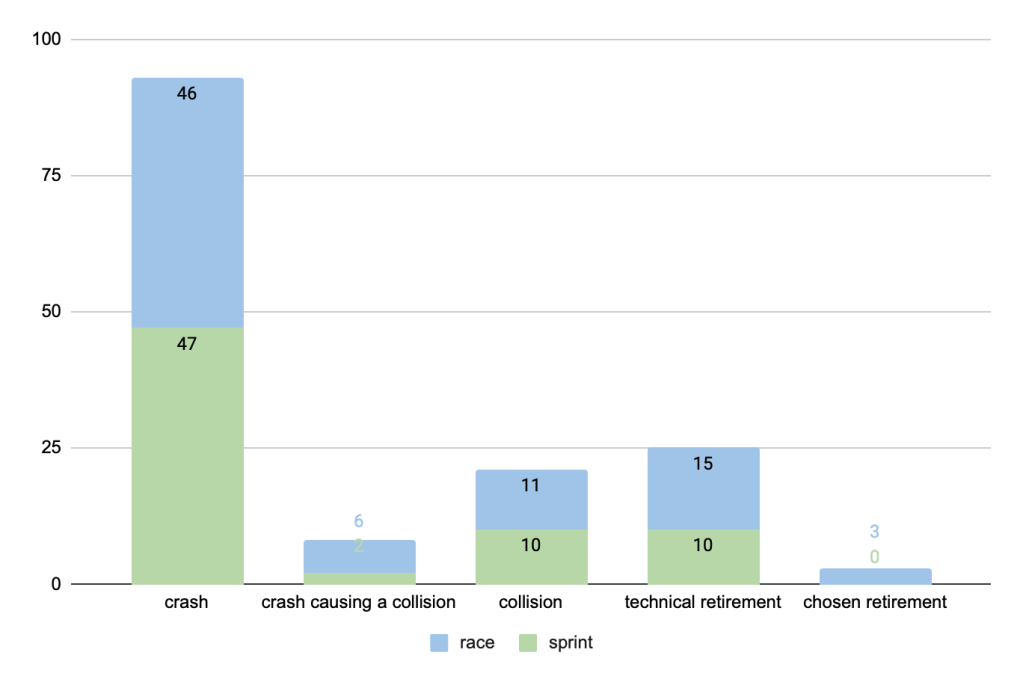
Repartition of DNFs per causes across sprints and races
We can notice that for incidents, the numbers of crashes where the rider was at fault (49 for sprints, 52 for races) and the number of crashes where the rider wasn’t at fault (10 for sprints, 11 for races) are relatively similar between sprints and races, despite the fact that races are double the length of sprints.
On the retirement side, whether it was technical or chosen, more of them occured on Sunday.
Overall, we can say that 2 times out of 3 (in 68.7% of cases to be exact), a MotoGP rider was at fault for not crossing the finish line.
who
by type of rider
| Type of Rider | Races Raced (including Sprints) | DNFs | % of DNFs |
|---|---|---|---|
| regular | 851 | 141 | 16.6% |
| wildcard + replacement | 45* | 9 | 20% |
*We observed 8 replacements and 15 wildcard riders in 2024 but Lorenzo Savadori didn’t ride on Sunday in Assen following his crash during the sprint.
When we take a closer look at the reason why replacement & wildcard riders (aka riders who ride a MotoGP bike way less often than the regular riders from the full-time grid) didn’t get to cross the finish line, we get this:
| Weekend | Round | Sprint / Race | Rider | Type | Factory | Type of DNF |
|---|---|---|---|---|---|---|
| Spain | 4 | sprint | Stefan Bradl | wildcard | Honda | crash |
| Spain | 4 | race | Dani Pedrosa | wildcard | KTM | crash |
| Spain | 4 | race | Lorenzo Savadori | wildcard | Aprilia | technical retirement |
| Netherlands | 8 | sprint | Lorenzo Savadori | wildcard | Aprilia | crash |
| Austria | 11 | sprint | Stefan Bradl | wildcard | Honda | technical retirement |
| San Marino | 13 | sprint | Stefan Bradl | wildcard | Honda | technical retirement |
| Japan | 16 | race | Lorenzo Savadori | replacement | Aprilia | technical retirement |
| Australia | 17 | race | Lorenzo Savadori | replacement | Aprilia | technical retirement |
| Thailand | 18 | race | Lorenzo Savadori | replacement | Aprilia | crash |
A total of 9 DNFs is not a very big total to draw conclusions from but we can still notice the fact that half of those DNFs were caused by crashes and the other half was caused by technical retirements, a repartition very different to what we found overall earlier.
That said, we have to keep in mind that wildcards are allowed to test different pieces (potential future evolution of the bikes) compared to factory and satellite riders. This means they’re riding with a different bike that might not have the perfect set-up yet for the evolutions they are competing with.
by factory
Now. Joan Mir (15) and Johann Zarco (8) top the charts in terms of DNFs while Luca Marini (4) and Takaaki Nakagami (5) are more towards the end of the list. Jorge Martin and Enea Bastianini (3) had the fewest amount of DNFs on the grid (along with Fabio Quartararo) meanwhile Pecco Bagnaia and Marco Bezzecchi (8) both share P3 of the DNFs standings with Johann Zarco and Pedro Acosta.
This begs a question: are some factories more prone to not finishing races or is it just a rider specific thing?
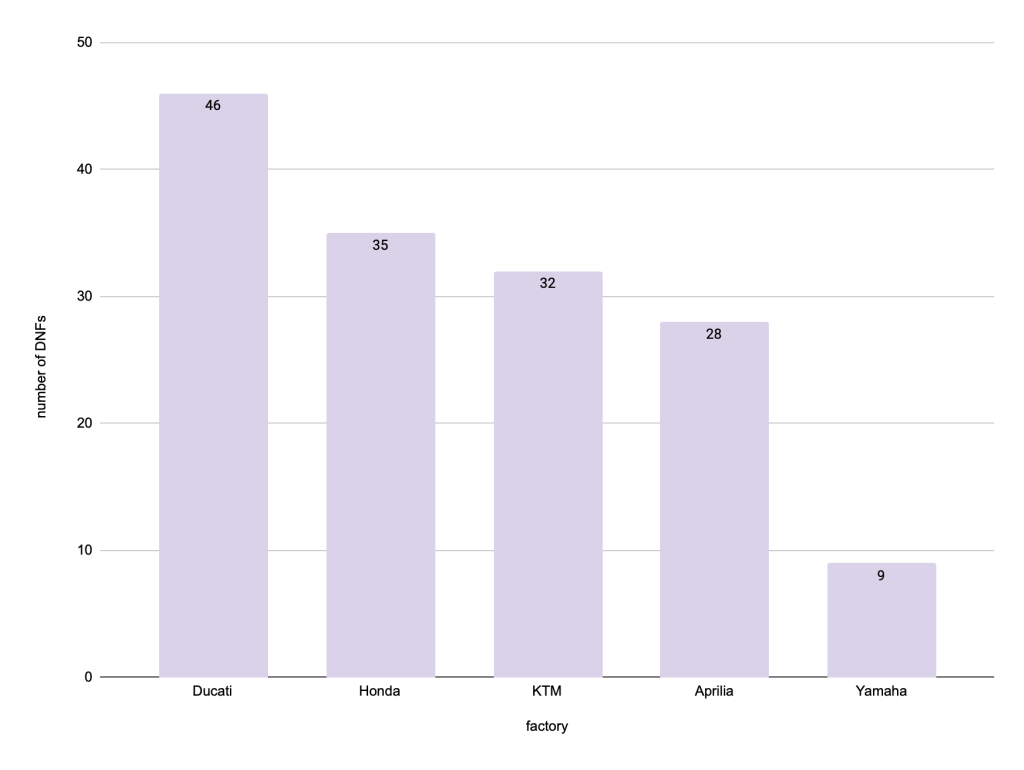
DNFs per factory
Is Ducati having the most amount of DNFs a surprise? Obviously not, they have the most amount of riders on the grid. Same thing with Yamaha being last, the other way around. To be critical of these numbers, we need to take into account the amount of races started for each factory.
Races started are obviously directly connected with the number of riders a factory has on the grid but that data allows us to take into account injured riders (not always replaced) and wildcards (varying numbers depending on factories).
| Factory | Races Started (including Sprints) | DNFs | % of Races DNFed |
|---|---|---|---|
| Honda | 169 | 35 | 20,7% |
| KTM | 167 | 32 | 19,2% |
| Aprilia | 162 | 28 | 17,3% |
| Ducati | 318 | 46 | 14,5% |
| Yamaha | 80 | 9 | 11,3% |
Now we can actually see a difference. Both the Hondas and KTMs tended to not finish 1 in 5 races meanwhile Yamaha was more around 1 in 9 races.
Last November, when I did my overall analysis of the 2024 season, I put the numbers together only for the regular riders. The numbers don’t change much but you can find them over there anyway if you’re curious.
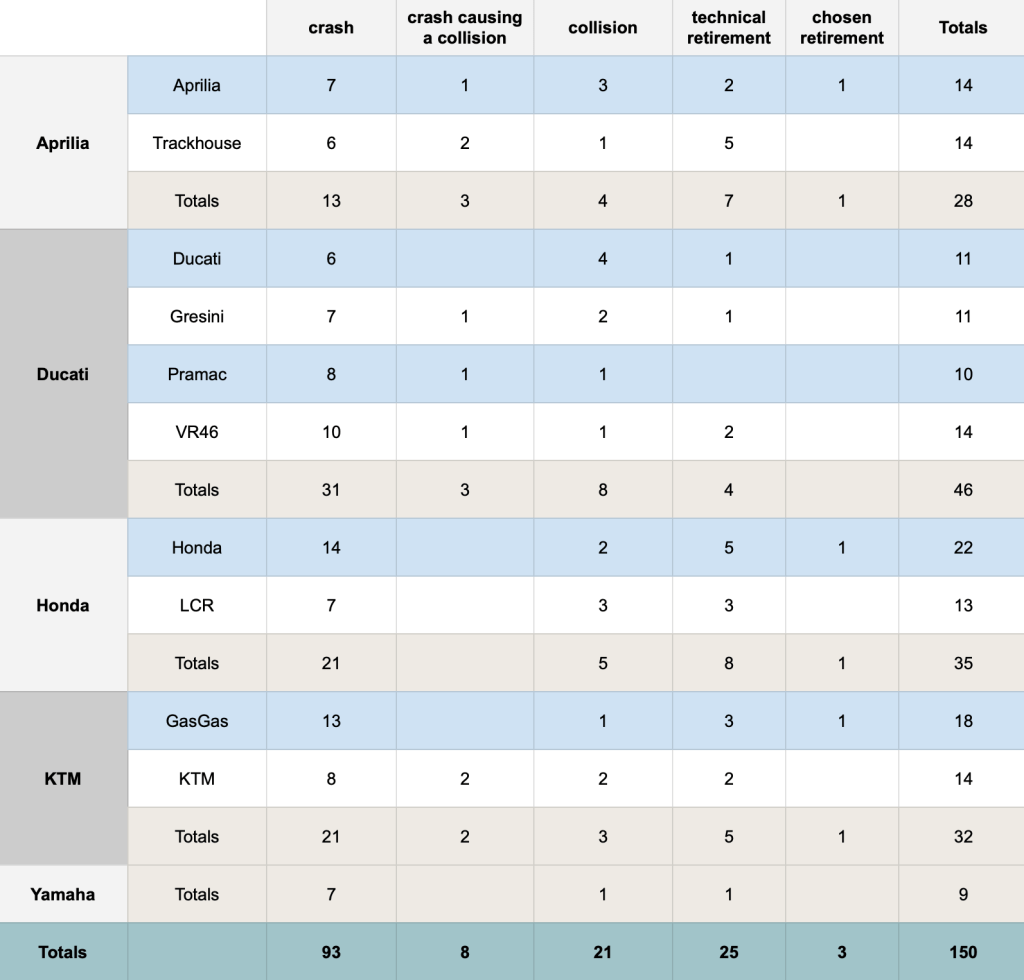
DNFs per team and per cause
If we translate this to % for the repartition of DNFs causes per factory, we obtain the following table.
| Factory | Crashes | Crashes causing a collision | Collisions | Technical Retirements | Chosen Retirements |
|---|---|---|---|---|---|
| Aprilia | 46,4% | 10,7% | 14,3% | 25,0% | 3,6% |
| Ducati | 67,4% | 6,5% | 17,4% | 8,7% | -% |
| Honda | 60,0% | -% | 14,3% | 22,9% | 2,9% |
| KTM | 65,6% | 6,3% | 9,4% | 15,6% | 3,1% |
| Yamaha | 77,8% | -% | 11,1% | 11,1% | -% |
| Totals | 62,0% | 5,3% | 14,0% | 16,7% | 2,0% |
One thing that jumps out to me is Ducati being the second team with the least amount of technical retirements (behind Yamaha) despite having the highest amount of races started.
The 4 technical retirements for Ducati were the following:
- Fabio Di Giannantonio during the sprint in COTA (technical issues I couldn’t find much information on),
- Pecco Bagnaia during the sprint in Le Mans (which you could argue was not a technical retirement considering the fact that Davide Tardozzi said that nothing was wrong with the bike but filing that one as a chosen retirement kind of felt wrong still, feel free to interpret it as you want, I’ll honestly understand),
- Fabio Di Giannantonio during the race in Sachsenring (technical issues I couldn’t find much information on),
- Marc Marquez during the race in Mandalika (engine blew up).
(This list can grow a 5th element depending how you consider Marc’s COTA DNF, as detailed earlier.)
If we focus on the technical retirements some more, we can look at the following numbers.
| Factory | Races Stared | DNFs | Technical Retirements | % of TR amongst Races Started | % of TR amongst DNFs |
|---|---|---|---|---|---|
| Ducati | 318 | 46 | 4 | 1,3% | 8,7% |
| Yamaha | 80 | 9 | 1 | 1,3% | 11,1% |
| KTM | 167 | 32 | 5 | 3,0% | 15,6% |
| Aprilia | 162 | 28 | 7 | 4,3% | 25,0% |
| Honda | 169 | 35 | 8 | 4,7% | 22,9% |
A Ducati and a Yamaha had bike issues once every 80 starts meanwhile an Aprilia or an Honda had an issue once every 21 (Honda) to 23 starts (Aprilia). KTM were doing a little better with an issue once every 33 starts an average (still far from the Ducati & Yamaha numbers).
specific riders
overall
The repartition per rider inside of the factories is given below.
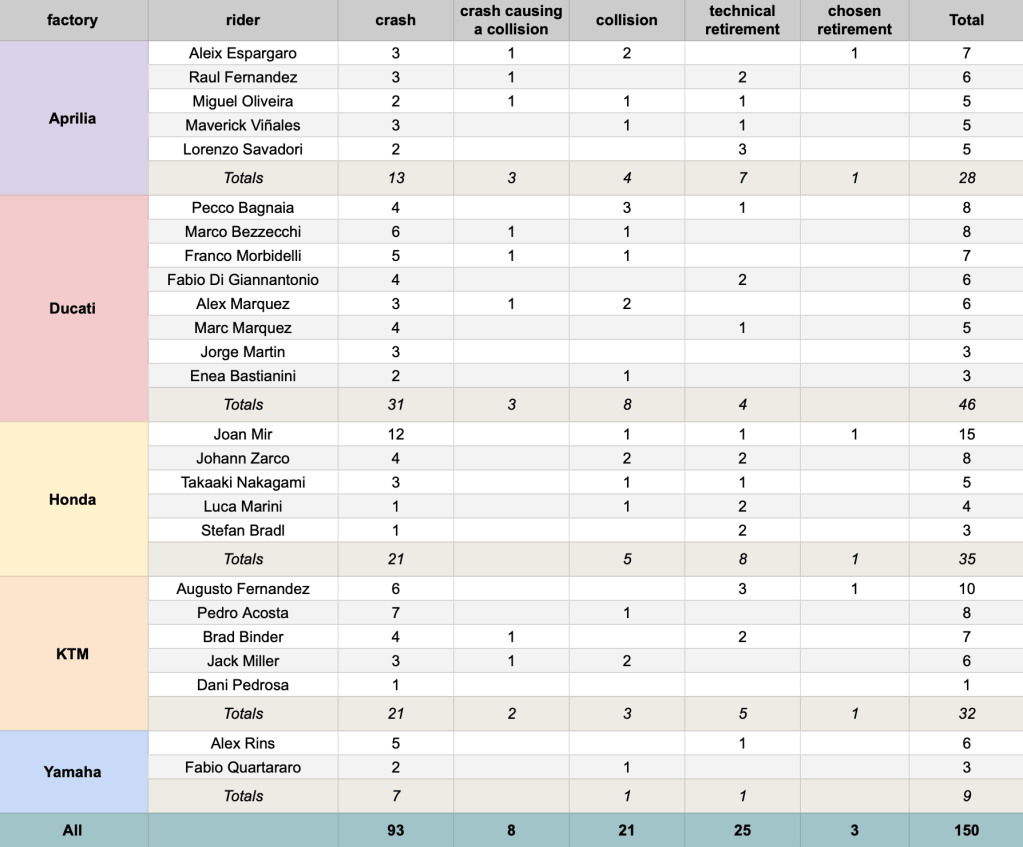
DNFs per rider and per cause
In the following sections, I’ve decided to take a look into what happened to specific riders.
Pecco Bagnaia
Pecco Bagnaia had 8 DNFs in 2024, something he’s underlined as one of the main reasons he didn’t win the title last season. For comparison, in 2024 he had 7 crashes in all sessions (practice and qualifying included) and 5 of those happened during races.
| Weekend | Round | Sprint / Race | Position | Initial Cause of the DNF | % of the race completed |
|---|---|---|---|---|---|
| Portugal | 2 | race | 5 | collision | 92% |
| Spain | 4 | sprint | 5 | collision | 17% |
| France | 5 | sprint | – | technical retirement | 15% |
| Catalunya | 6 | sprint | 1 | crash | 92% |
| Great Britain | 10 | sprint | 4 | crash | 40% |
| Aragon | 12 | race | 3 | collision | 74% |
| Emilia-Romagna | 14 | race | 3 | crash | 74% |
| Malaysia | 19 | sprint | 2 | crash | 20% |
Now, when we look at the details, we can see that Pecco crashed on his own on 4 occasions (3 times during sprints: Barcelona, Silverstone, Sepang + one time on Sunday with the second race in Misano).
He had the technical retirement in Le Mans, the one that will probably always be a little mysterious considering what little information we got about it (when not conflicting).
And finally, the part where he was indeed unlucky, even though all 3 collisions where deemed « race incidents » by Race Direction:
- the crash with Marc Marquez in the Portimao race,
- the crash in the Jerez sprint where he got squeezed between Brad Binder and Marco Bezzecchi at turn 1,
- the crash with Alex Marquez in the Aragon race.
Joan Mir
Considering the fact that he had the most DNFs out of anyone on the grid in 2024, I thought we should do a short focus on what happened to Joan Mir.
| Weekend | Round | Sprint / Race | Position | Initial Cause of the DNF |
|---|---|---|---|---|
| USA | 3 | sprint | 19 | crash |
| USA | 3 | race | 19 | crash |
| France | 5 | sprint | 21 | crash |
| France | 5 | race | 15 | crash |
| Italy | 7 | sprint | – | technical retirement |
| Italy | 7 | race | 19 | crash |
| Netherlands | 8 | race | 15 | crash |
| Great Britain | 10 | race | – | chosen retirement |
| Indonesia | 15 | sprint | 18 | crash |
| Indonesia | 15 | race | 14 | crash |
| Japan | 16 | sprint | 16 | crash* |
| Japan | 16 | race | 14 | collision |
| Australia | 17 | race | 18 | crash |
| Malaysia | 19 | race | 18 | crash |
| Solidarity | 20 | race | 13 | crash |
*The situation on the sprint in Japan is also one of the ones that maybe could have been classified differently. Joan crashed on lap 1, rejoined the race and then eventually retired back to the pits on the last lap of the sprint, 10 laps later. I wasn’t able to find more information about that decision so I’ve left the crash as the initial reason for the DNF.
I’ve mentioned the Silverstone situation earlier and regarding the Mugello sprint, Joan actually had a good start (gaining places) but he said he had to retire due to vibrations issues with his bike.
Except for those ones and Alex Marquez getting into him in Motegi, all other DNFs were caused by crashes he had on his own, mostly from the back of the grid. The broadcasts didn’t always show the incidents so I wasn’t able to quantify which ones where big / easy / lowsides / highsides but in any case, they were never violent enough for him to injure himself (contrary to 2023). The only races Joan missed where the sprint and the race of the first Misano weekend (sickness).
Marc Marquez
Because his season was actually so refreshing to see after 2023 (reminder that that season, it took him until the 10th round to cross the finish line on a Sunday) and because it’s a testament to the way he’s grown used to the Ducati throughout the year, I’ll finish these special studies with the case of Marc.
| Weekend | Round | Sprint / Race | Position | Initial Cause of the DNF | % of the race completed |
|---|---|---|---|---|---|
| USA | 3 | race | 1 | crash | 50% |
| Netherlands | 8 | sprint | 5 | crash | 8% |
| Great Britain | 10 | sprint | 4 | crash | 80% |
| Austria | 11 | sprint | 2 | crash | 64% |
| Indonesia | 15 | race | – | technical retirement | 41% |
Reading this, you have to keep in mind that this is about the races where he didn’t cross the finish line. This does not account for incidents where he then rejoined the race (ex: the races in Portimao or Sepang for example).
Marc’s first 4 DNFs of the season were due to crashes on his own, although, as I mentioned earlier, the one in COTA he attributes to break issues. Those incidents always happened from a top 5 position.
Finally, Marc had the second technical retirement of his MotoGP career (after Silverstone in 2017) when his engine blew up on Sunday in Mandalika.
when
at which point of the race
notes
The % of the race completed has been calculated using the number of full laps completed (compared to the total amount of laps). Therefore, it’s quite close to reality when a rider crashed at the beginning of a lap and a little too low when a rider crashed in sector 4, for example.
results
Overall
Only considering riders who had a DNF, let’s see how much of the race they managed to complete.
Keeping in mind what I said in the notes of this section (the exact % are under evaluated) and noting that lap 1 incidents have been considered at 2% of completion. Also, adjustments have been made to render the data correctly in the chart under.
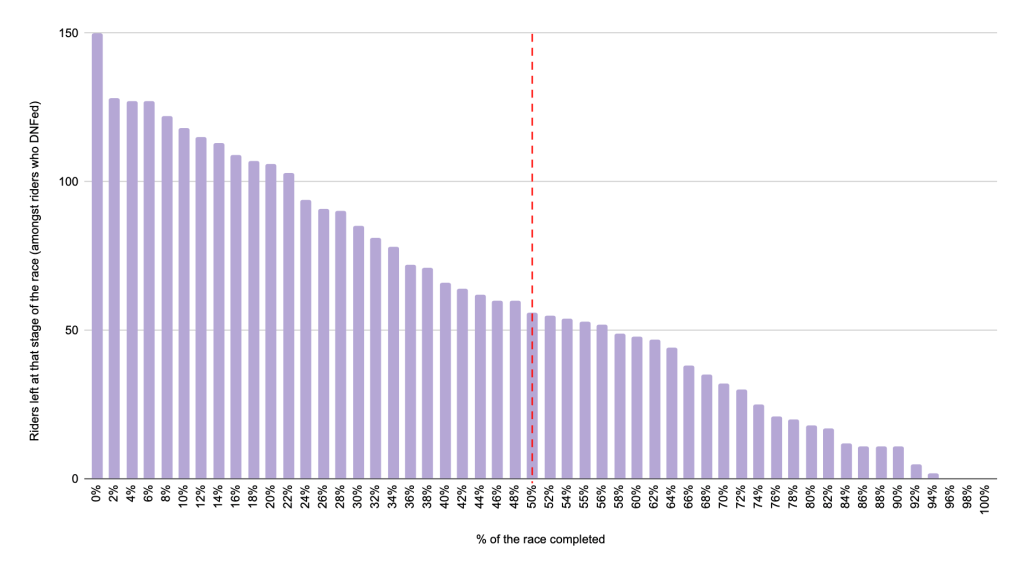
% of the race completed – Riders who had a DNF
We can notice the major drop of the first lap incident (15% of all DNFs). Also, by the midway point of races, we had already lost almost two thirds of riders who had a DNF (37.3% of them occured during the second half of races).
first lap
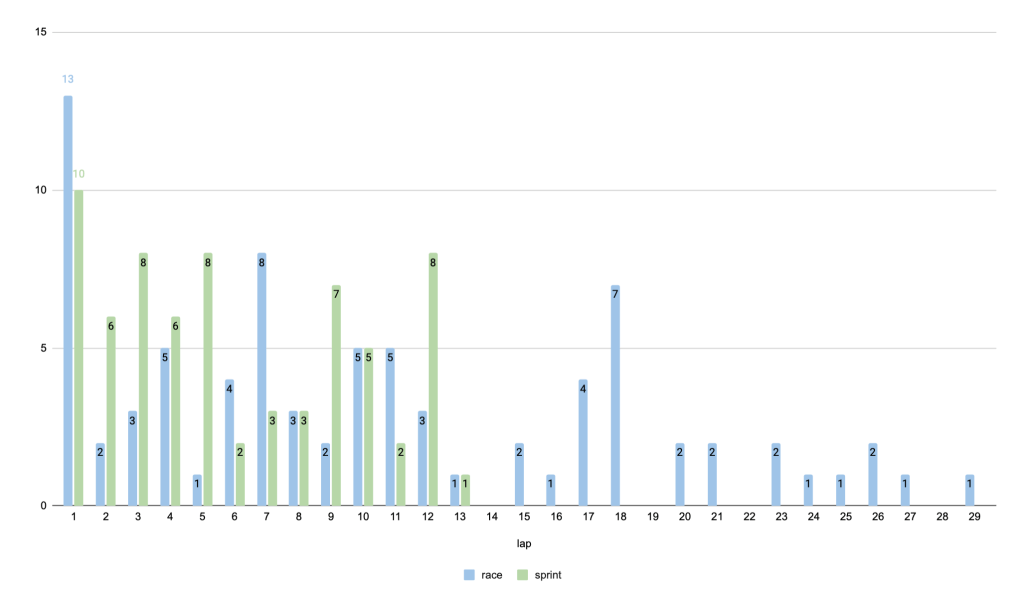
DNFS per laps
As per the above chart, you can see that lap 1 was the most damaging in terms of incidents. All 23 DNFs are due to crashes except from one technical retirement (Brad Binder in the Silverstone race).
At least* half of those crashes (11 in 22) happened in the first three turns (10 in the first 2, even).
*I’ve tried my best to identify the turns where DNFs occured but it wasn’t always a possibility depending on the replays or information we were given in the broadcasts.
These incidents happened over the course of 12 races:
| Weekend | Sprint / Race | Number of lap 1 DNFs |
|---|---|---|
| COTA | sprint | 3 |
| Jerez | sprint | 1 |
| Assen | race | 1 |
| Silverstone | sprint | 2 |
| Silverstone | race | 3 |
| Aragon | sprint | 1 |
| Aragon | race | 1 |
| Mandalika | race | 3 |
| Motegi | sprint | 1 |
| Motegi | race | 3 |
| Sepang | race | 1 |
| Solidarity | sprint | 1 |
last lap
On the opposite side of the spectrum, we had a couple of occasions where riders were so very close to the finish line but simply couldn’t get the job done.
| Weekend | Sprint / Race | Rider | Team | Position | Reason for the DNF |
|---|---|---|---|---|---|
| Portimao | race | Maverick Viñales | Aprilia | 3 | crash* |
| Jerez | sprint | Stefan Bradl | Honda | 13 | crash |
| Jerez | sprint | Luca Marini | Honda | 12 | crash |
| Barcelona | sprint | Pecco Bagnaia | Ducati | 1 | crash |
| Assen | sprint | Aleix Espargaro | Aprilia | 6 | crash |
| Assen | race | Pedro Acosta | GasGas | 7 | crash |
*As mentioned earlier, the Maverick crash from Portimao was not exactly on him (and he started having issues when he was P2 at the beginning of that last lap).
from which position
notes
In some cases, the position from which a rider crashed was fairly evident (especially when he was riding alone / with enough of a gap to other riders).
In case of collisions, it was sometimes hard to decide who was ahead of who and when riders where crashing from the back of the grid, I didn’t necessarily have the information (but I’ve made the best guesses using their position at the end of the last lap they completed).
For crashes happening on lap 1 (especially in the very first turns), I used the grid position of riders.
For retirements, considering the fact that it wasn’t always easy to pinpoint when the bikes started causing issues to their riders, I decided to not register the DNF position.
results
overall
Note: In the chart under, Honda has been represented in green for readability purposes.

DNFs per position per factory
Fun fact: we’ve had at least two DNFs from every single position from P1 to P21. And it’s actually quite interesting to not have any DNF from P22 considering the fact that 85% of the 2024 races had at least 22 riders starting and we’ve observed DNFs from the very back of the grid in 2024 (not from P22 or more, though).
Per Factory
- Aprilia (average DNF position: 10.7)
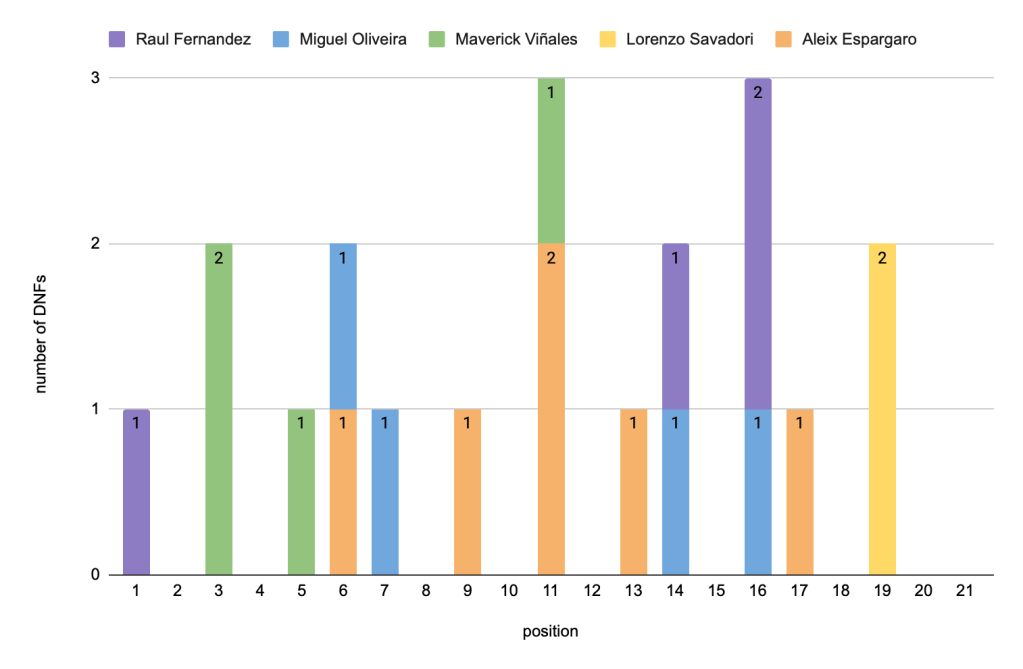
DNFs per position / Aprilia riders
A little all over the place with incidents ranging from P1 to P19 and an average right in the middle of the pack (10.7). Feels very representative of Aprilia’s 2024 season as a whole.
- Ducati (average DNF position: 6.7)
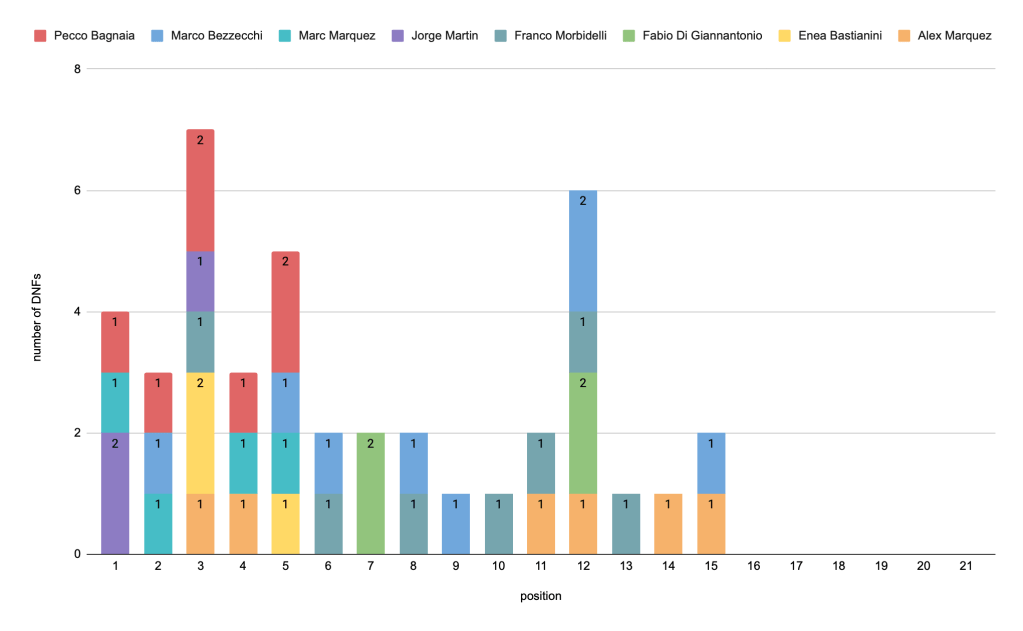
DNFs per position / Ducati riders
Results that are definitely more top positions heavy. We can notice that 3 of the GP24s (Pecco Bagnaia, Enea Bastianini and Jorge Martin) + Marc Marquez never had an incident (whether on their own or with someone else) from a lower position than P5.
- Honda (average DNF position: 16.4)
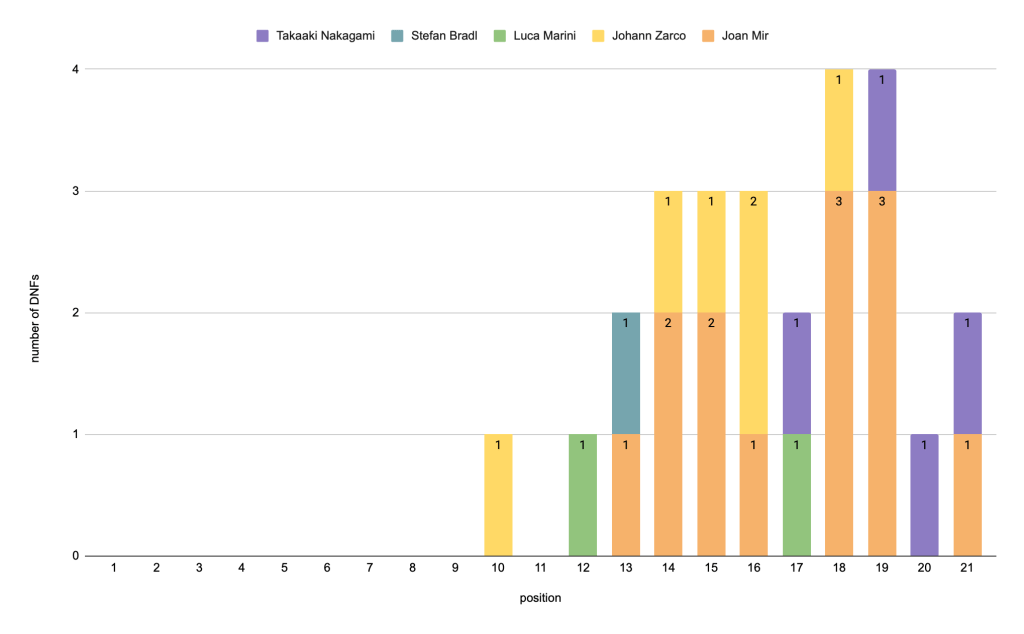
DNFs per position / Honda riders
The opposite of the Ducati data, in a way. Much more bottom position heavy, which is consistent with the positions Honda riders were running during the 2024 season. The highest position they crashed from was P10 (Johann Zarco in the Aragon sprint).
For complementary information, the highest finishes achieved by Honda riders last season were (sprints & races included) : a P8 for Johann Zarco, a P9 for Joan Mir and a P10 for Luca Marini and Takaaki Nakagami.
- KTM (average DNF position: 8.9)
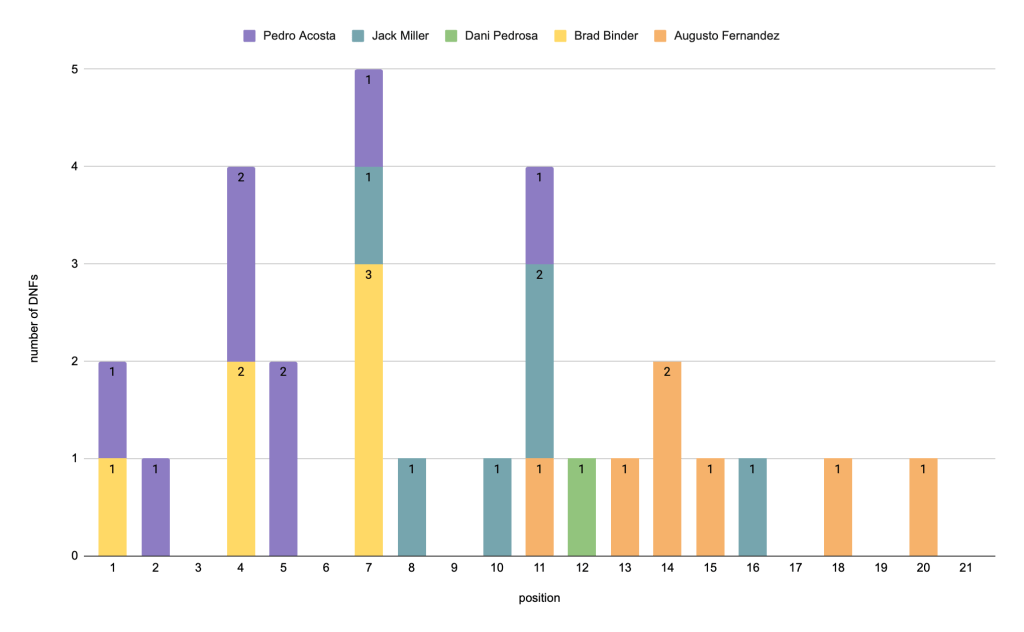
DNFs per position / KTM riders
Despite its slightly better average, KTM is much like Aprilia: all over the place. While Aprilia riders were all using the whole spectrum of positions to have an incident from, KTM riders were all doing their own thing.
Except for the one Pedro Acosta P11 crash (sprint in Australia), he and Brad Binder never crashed from lower than P7. Jack Miller had crashes from middle of the pack positions (P7 to P16) meanwhile Augusto Fernandez mostly fell from the back of the grid (from P11 to P20).
Just like with Ducati and Aprilia, these results mirror the finishing results achieved by KTM riders and where we were used to see them hang out during races.
- Yamaha (average DNF position: 12.8)
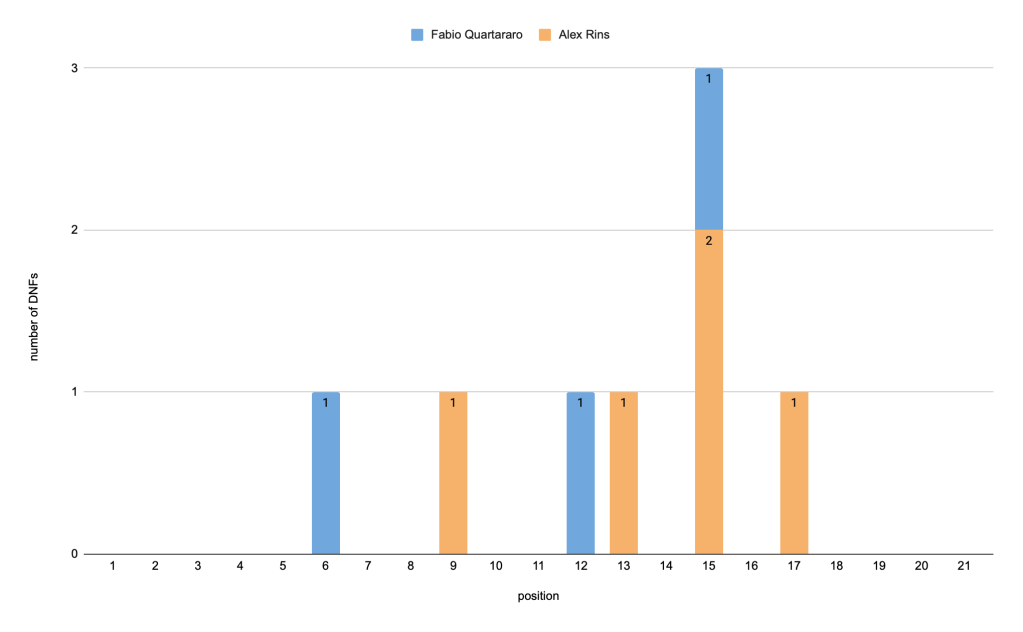
DNFs per position / Yamaha riders
Truthfully not much to say here with how limited the data is, all of these were crashes except for Fabio Quartararo being taken out of the Mugello sprint (in P15) by Miguel Oliveira. Crashes matching with the average results from both Yamaha riders.
from the lead
Let’s focus on riders who lost it while they were leading the race.
| Weekend | Round | Sprint / Race | Rider | Initial cause of the DNF | % of the race completed |
|---|---|---|---|---|---|
| USA | 3 | race | Marc Marquez | crash | 50% |
| Spain | 4 | race | Jorge Martin | crash | 40% |
| Catalunya | 6 | sprint | Raul Fernandez | crash | 33% |
| Catalunya | 6 | sprint | Brad Binder | crash | 50% |
| Catalunya | 6 | sprint | Pecco Bagnaia | crash | 92% |
| Germany | 9 | race | Jorge Martin | crash | 93% |
| Japan | 16 | sprint | Pedro Acosta | crash | 67% |
As I’ve mentioned previously in this article, this doesn’t take into account crashes where the rider rejoined the race afterward (e.g. Jorge Martin in the Mandalika sprint).
Talking about Jorge Martin, he figures twice in this table. His only other DNF of 2024 also came from a crash on his own, during the Mugello sprint. He’s the only rider who appears more than once in the above table.
One interesting thing to note is the fact that all but one of these DNFs happened in the first half of the season (and famously, 3 of them on the same day: Saturday in Catalunya, the first time we went there).
Also, in 5 out of 7 cases (71%), the incident happened on the second half of the race (Jorge Martin wasn’t that far out in Jerez, having crashed out on lap 11 out of 25).
from a podium position
| Weekend | Round | Sprint / Race | Rider | Position | Initial Cause of the DNF | % of the race completed |
|---|---|---|---|---|---|---|
| Portugal | 2 | race | Maverick Viñales | 3* | crash | 96% |
| Spain | 4 | sprint | Alex Marquez | 3 | crash | 67% |
| Spain | 4 | sprint | Maverick Viñales | 3 | crash | 75% |
| France | 5 | sprint | Marco Bezzecchi | 2 | crash | 69% |
| Italy | 7 | sprint | Enea Bastianini | 3 | collision | 36% |
| Italy | 7 | sprint | Jorge Martin | 3 | crash | 64% |
| Austria | 11 | sprint | Marc Marquez | 2 | crash | 64% |
| Aragon | 12 | race | Pecco Bagnaia | 3 | collision | 74% |
| San Marino | 13 | race | Franco Morbidelli | 3 | crash | 22% |
| Emilia-Romagna | 14 | race | Pecco Bagnaia | 3 | crash | 74% |
| Indonesia | 15 | race | Enea Bastianini | 3 | crash | 74% |
| Japan | 16 | race | Pedro Acosta | 2 | crash | 50% |
| Malaysia | 19 | sprint | Pecco Bagnaia | 2 | crash | 20% |
*I mentioned Maverick’s case early in this article regarding the category for the initial cause of the DNF. I will just add here that while he was P3 when he crashed, he was technically P2 when his bike started slowing down.
Again, in most cases (10 in 13), more than half of the race had been completed by the time the incident happened. Contrary to the DNFs from P1, though, they’re more equally spread between the first and the second half of the season. I find this even more interesting to not considering the fact that only one third of all DNFs happened on the second half of the race.
For both the collision incidents (Enea Bastianini with Jorge Martin in the Mugello sprint and Pecco Bagnaia with Alex Marquez in the Aragon race), Race Direction opinionated that they were racing incidents.
For the Aragon incident, it could be argued that Pecco crashed from P4 (that’s where he comes from when he makes the move on Alex but his bike is in front when they collide together and then hit the ground).
In Mugello, Enea was racing in P3 and they were mostly side by side when Jorge Martin squeezed in too tight and made Enea crash (while Jorge remained on his bike).
where
by circuit
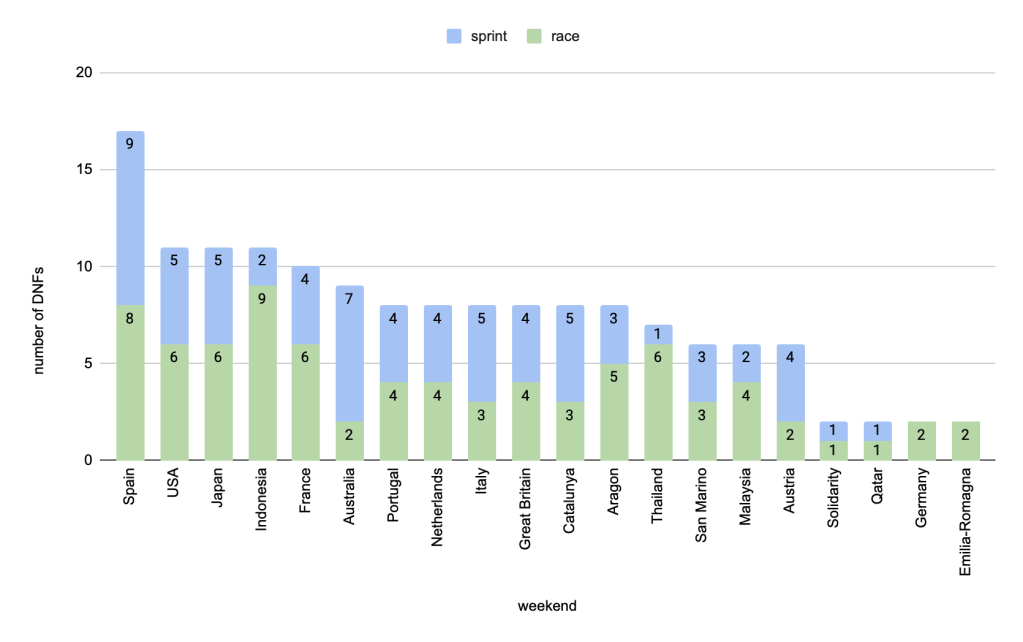
DNFS per race weekend
First of all, looking at the chart above we can notice that we observed at least one DNF every Sunday in 2024 but we had two sprints where everybody who started the race also crossed the finish line: Sachsenring and Emilia-Romagna (second race in Misano).
In addition to that, they only had two DNFs during the race, making them the safest weekends of the season alongside Qatar and the Solidarity GP where we observed one DNF on Saturday and one on Sunday.
Note: I intentionally separated the numbers by race weekends but if we add the Misano 1 and Misano 2 numbers, Misano as a circuit falls P7 in those rankings (alongside other circuits). If we do the same thing with both rounds in Barcelona, the circuit of Barcelona-Catalunya moves to P5 with Le Mans.
The race with the most amount of DNFs (9) was also the race with the least amount of finishers (12) : Sunday in Mandalika.
The wet patches in Jerez and a track that looked like an ice rink during the sprint helped put Jerez in that first spot. We also had 9 DNFs in the Jerez sprint but 25 riders took part in that sprint (hence a higher number of finishers than Mandalika).
Meanwhile Le Mans was a fully sunny weekend (albeit with a grey sky on Sunday but not a single drop of rain), it’s not surprising to see it that high considering the crashes numbers there in the past (you can find interesting data on this subject here).
by specific corner
Whenever I could (whenever the information was available), I also logged in the corner where DNFs were occuring. Overall, the information is mostly missing for incidents that happened at the back of the grid (no replay and no turn displaying on the little graphic).
Putting aside the chosen and technical retirement, I have the corner data for 79% of incidents (most of them are missing from COTA where I only have it for 2 out of 9 crashes ending in a DNF).
Here under are the corners that had at least 3 separate incidents over a weekend.
For this list, I have put aside the incidents that happened in the first two corners of lap 1 (as I consider them inherent to first lap chaos more so than the nature of those corners in general).
- Turn 5 in Jerez
6 incidents during the sprint, including the famous moment where Alex Marquez, Brad Binder and Enea Bastianini all fell simultaneously on lap 9. This was due to the two wet patches that could be found at this place of the track. Coincidentally, turn 5 is also where Franco Morbidelli and Jack Miller had their incident on Sunday.
- Turn 8 in Jerez
Aleix Espargaro crashed there on lap 1 of the sprint. Then, on Sunday, Dani Pedrosa also crashed (lap 4) and the Aleix Espargaro and Johann Zarco incident happened there on lap 10.
- Turn 8 in Le Mans
This one did damage twice in the sprint (Joan Mir and Alex Rins) and then once in the race when Pedro Acosta had his first in-race crash of the season (on lap 3 while he was running P4).
- Turn 10 in Barcelona
It’s quite easy: the 3 DNFs from the first Sunday in Catalunya were all due to crashes at turn 10. It’s also where Raul Fernandez crashed from the lead on lap 5 of the sprint.
![Avatar de [MOTOGP – RESULTS] : A study of the 2025 season DNFs – virage du raccordement](https://virageduraccordement.com/wp-content/uploads/2025/12/icon.png?w=40)

![[MOTOGP – RESULTS] : A study of the 2025 season DNFs](https://virageduraccordement.com/wp-content/uploads/2026/02/54765052116_df71230554_o.jpg?w=1024)
![[MOTOGP – RESULTS] : Who did best within each team and each factory in 2025](https://virageduraccordement.com/wp-content/uploads/2025/12/54833282836_7c4a07bc5e_o.jpg?w=1024)
![[MOTOGP – SURVEYS] : People’s opinion on the 2025 season](https://virageduraccordement.com/wp-content/uploads/2025/12/img_5076.jpg?w=1024)
![[MOTOGP – RESULTS] : An overall look at the 2025 season](https://virageduraccordement.com/wp-content/uploads/2025/11/54816173937_898f5574e6_o.jpg?w=1024)
![[MOTOGP – RESULTS] : A check-up on the first 12 rounds of the 2025 season](https://virageduraccordement.com/wp-content/uploads/2025/07/54354125374_f3762ae206_o.jpg?w=1024)
![[MOTOGP – STUDIES] : Valentino Rossi and his performances by circuit (1996-2021)](https://virageduraccordement.com/wp-content/uploads/2025/05/12437219663_ebd575951a_o.jpg?w=1024)
 virage du raccordement
Laisser un commentaire