![[F1 – STUDIES] : Staying with your team or not? (the evolution of the F1 grid throughout seasons)](https://virageduraccordement.com/wp-content/uploads/2025/01/img_8095-2.jpg?w=1024)
Between a 2024 season that starred the same 20 drivers who finished the 2023 season and a 2025 season that will see 6 drivers have their rookie season, the F1 grid has evolved in different manners throughout the years and it’s time to take a closer look at the movements that have taken place over the last 13 years.
Note: If this all sounds familiar, it might be because you came across the article where I did the same thing for MotoGP.
introduction
The hypotheses:
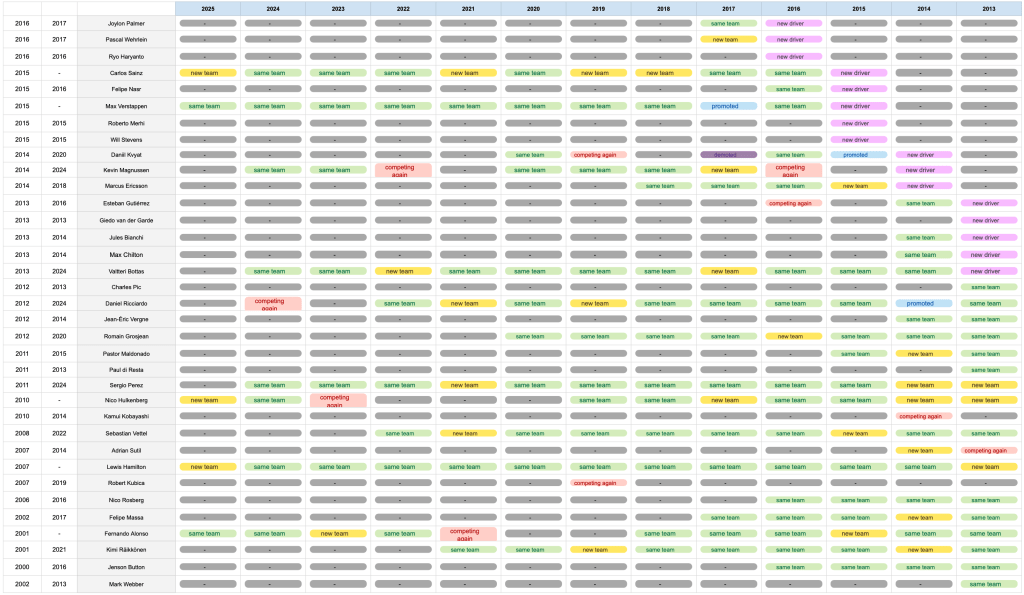
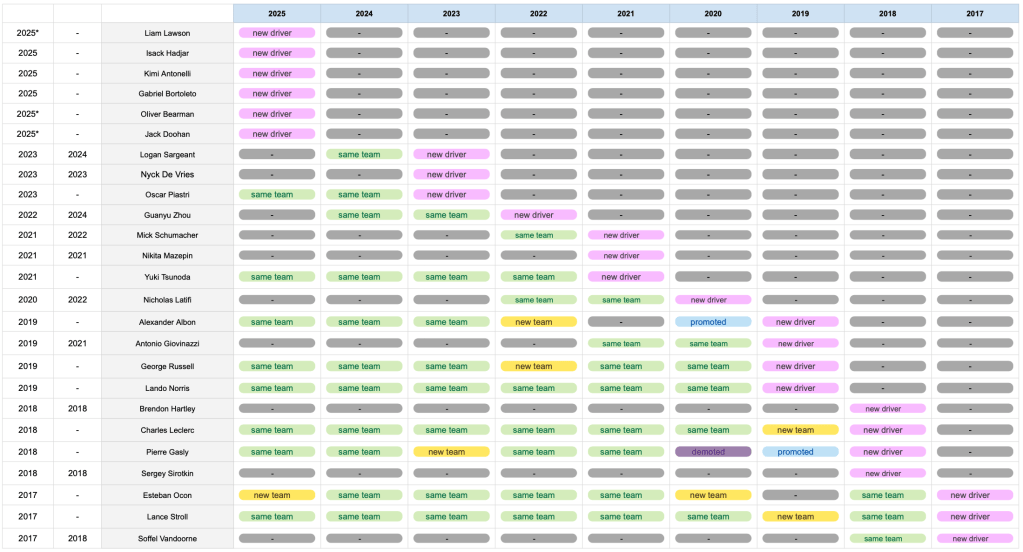
- To be awarded a category in a season, a driver had to have a full-time seat in a team at the beginning of the season.
- The comparison is made between the beginning of a season and the beginning of the previous season. This means that the changes from mid-season decisions only show up in the following season (example: Liam Lawson is considered a new driver in 2025 even though he competed several races in 2023 and 2024 ; likewise, Daniel Ricciardo has been considered as « competing again » in 2024 because he didn’t start the 2023 season with a seat).
- Seasons 2013 through 2025 have been considered in this study. This brought us a total of 60 drivers.
The categories:
- new driver : the rookies*,
- same team : self-explanatory,
- promoted / demoted : applies solely to Red Bull and Toro Rosso/Alpha Tauri/VCARB/Racing Bulls when moves were made between the two teams (ex: Max Verstappen and Daniil Kvyat in 2016, which reflected on the 2017 grid or Alexander Albon and Pierre Gasly in 2019, which reflected on the 2020 grid),
- competing again : a driver coming back with a full-time seat after not having one at the beginning of the previous season (ex: Daniel Ricciardo in 2024 or Fernando Alonso in 2021).
*I’m aware that the definition of rookies is kind of a discussion right now (people saying we will have 6 rookies on the grid next season versus people saying you’re no longer having your rookie season if you have raced at least 2 F1 races in the past). For the purpose of this article, new drivers follow the definition I’ve laid out in the hypotheses i.e. drivers who have not started any season with a seat before (which will indeed be the case of 6 of the guys in 2025).
overall results
| season | new driver | same team | promoted | demoted | new team | competing again | total |
|---|---|---|---|---|---|---|---|
| 2025 | 6 | 10 | 0 | 0 | 4 | 0 | 20 |
| 2024 | 0 | 19 | 0 | 0 | 0 | 1 | 20 |
| 2023 | 3 | 14 | 0 | 0 | 2 | 1 | 20 |
| 2022 | 1 | 15 | 0 | 0 | 3 | 1 | 20 |
| 2021 | 3 | 12 | 0 | 0 | 4 | 1 | 20 |
| 2020 | 1 | 16 | 1 | 1 | 1 | 0 | 20 |
| 2019 | 4 | 8 | 1 | 0 | 5 | 2 | 20 |
| 2018 | 4 | 15 | 0 | 0 | 1 | 0 | 20 |
| 2017 | 3 | 11 | 1 | 1 | 4 | 0 | 20 |
| 2016 | 3 | 16 | 0 | 0 | 1 | 2 | 22 |
| 2015 | 5 | 11 | 1 | 0 | 3 | 0 | 20 |
| 2014 | 3 | 11 | 1 | 0 | 6 | 1 | 22 |
| 2013 | 5 | 13 | 0 | 0 | 3 | 1 | 22 |
| total | 35 | 161 | 5 | 2 | 33 | 10 | 246 |
| average | 3.2 | 13.2 | 0.4 | 0.2 | 2.8 | 0.8 | 20.5 |

Repartition of drivers at the beginning of each season (in regard to who they were driving for at the beginning of the previous season) – Chart
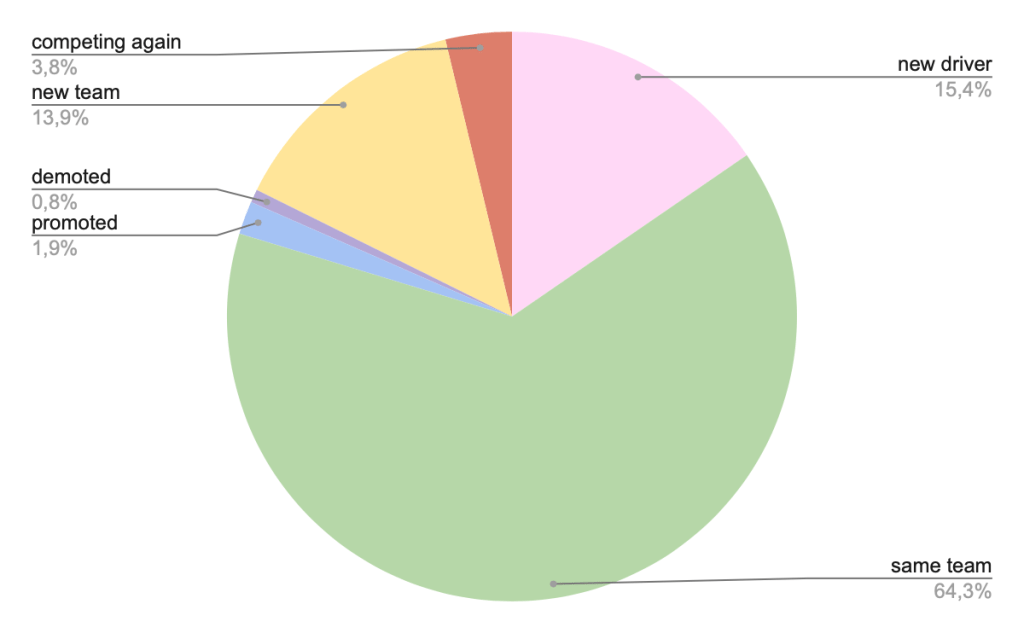
On average, in a new season, between 2013 and 2025, we have gotten :
- 3 rookies,
- 13 drivers staying with their team,
- 3 drivers changing teams,
- 1 driver coming back after a break from F1.
new drivers
Over the last 13 seasons, F1 has welcomed 35 rookies. This does not account for the occasional moments where a driver might have filled in for someone else in passing but not starting the season (ex: Franco Colapinto with Williams in 2024).
The highest number of new drivers as per the definition I set up early on, is 6, as we are expecting in 2025. 2013 and 2015 are close behind as they stand as seasons that welcomed 5 new drivers on the grid.
Fun fact: of those 10 drivers in total from 2013 and 2015, only two of them will be part of the 2025 grid and they were both teammates at Toro Rosso in 2015, I’ve named: Max Verstappen and Carlos Sainz.
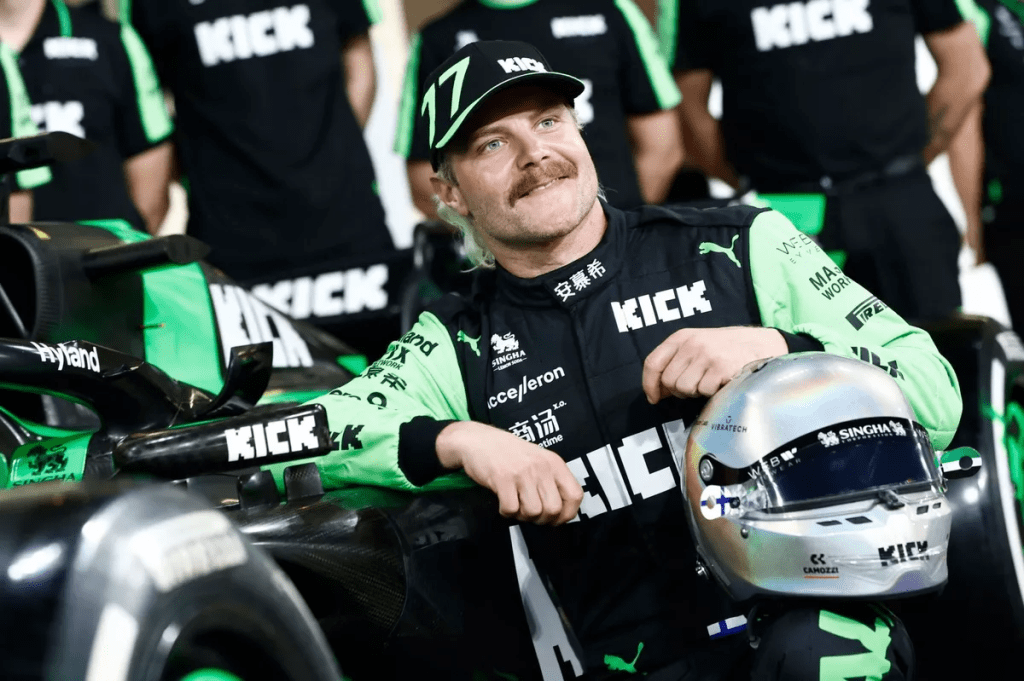
In 2024, we leave behind the last rookie of the 2013 season: Valtteri Bottas.
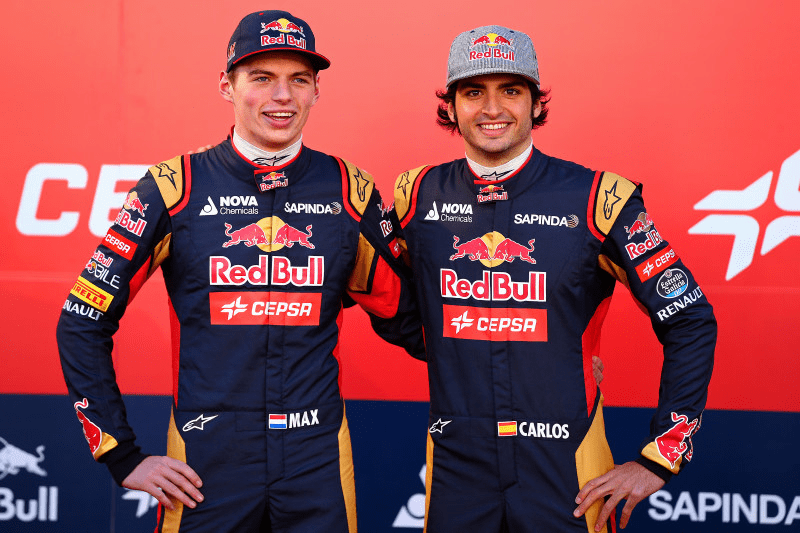
Not counting 2025, 7 drivers only did one season in F1. Nyck De Vries was the most recent in history (didn’t even get to finish the 2023 season). Before him, we had Nikita Mazepin in 2021 (who theoretically was supposed to start in 2022 before Russia’ s invasion of Ukraine).
In 2018, two rookies only stayed for a year: Brendon Hartley and Sergey Sirotkin. Earlier than that, the same fate was suffered by Ryo Haryanto (2016). In 2015, Marussia had a duo of rookies who had complicated seasons (neither of them scoring a single point) and neither of them got a second chance in F1 the following season (or at any other time): Will Stevens and Roberto Mehri. The latter was even replaced by Alexander Rossi for 5 GPs during the season.
staying with their team
as individuals
As stated above in this article, on average, over the 2013-2025 period, 13.2 drivers started the season on the same team they had started the previous season. In terms of extremes :
- 2024 appeared as the truly anomaly with 19 drivers starting the season in the same team they started 2023 (plus Daniel Ricciardo who replaced Nyck De Vries and finished the 2023 season with VCARB before starting 2024 with them as well),
- In 2019, only 8 drivers started the season in the same team they started 2018 with.
If we look at the riders with the longest tenure with the same team, we get the following table.
| Driver | Team | Number of Consecutive Seasons with the same team | Dates |
|---|---|---|---|
| Lewis Hamilton | Mercedes | 12 | 2013-2024 |
| Max Verstappen | Red Bull | 9.5 | mid 2016-2025 |
| Lance Stroll | Racing Point / Aston Martin | 7 | 2019-2025 |
| Charles Leclerc | Ferrari | 7 | 2019-2025 |
| Lando Norris | McLaren | 7 | 2019-2025 |
| Sergio Perez | Force India / Racing Point | 7 | 2014-2020 |
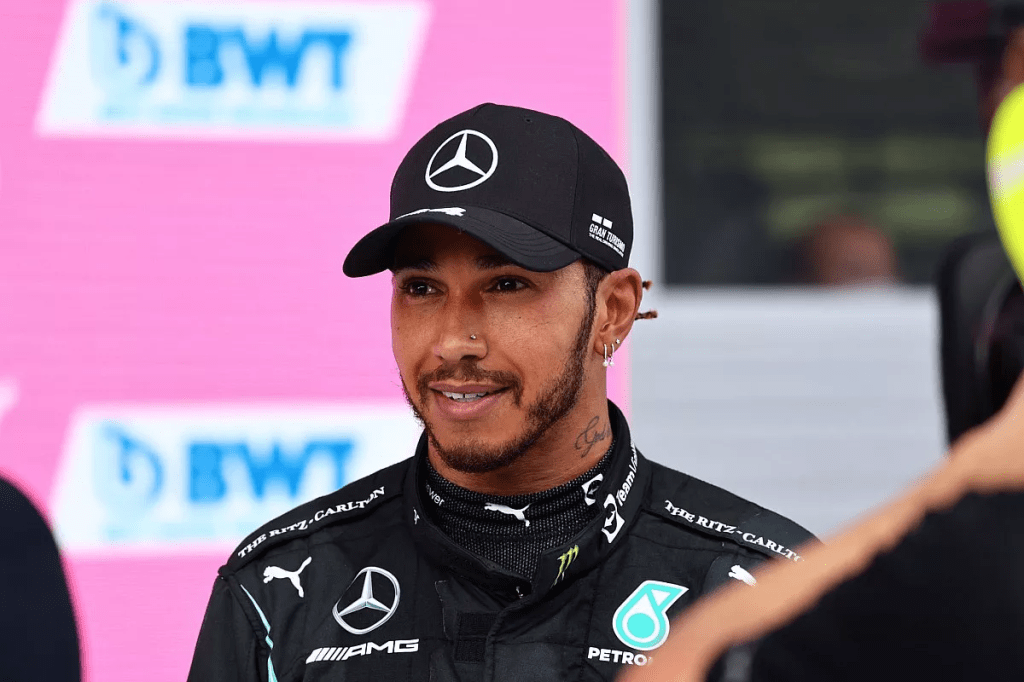
For the purpose of this article, and because the contracts have been signed, I have considered 2025 as a full season done with their team. Maybe the future will prove the numbers wrong but that’s a risk I am willing to take today (one I consider reasonable because I think it would take something for the seasoned drivers listed above to be fired mid-2025).
I’ve only looked at the data from 2013 on but if we go a little further back, Nico Rosberg did 7 seasons with Mercedes between 2010 and 2016.
Considering the 2025 grid, after the top 5 in the table, the next drivers who have been with their 2025 team the longest are Yuki Tsunoda (with Alpha Tauri/VCARB/Racing Bulls since 2021), Alexander Albon and George Russell (respectively with Williams and Mercedes since 2022).
as teammates
| Drivers | Team | Consecutive Seasons spent together | Period |
|---|---|---|---|
| Lewis Hamilton / Valtteri Bottas | Mercedes | 5 | 2017-2021 |
| Max Verstappen / Sergio Perez | Red Bull | 4 | 2021-2024 |
| Carlos Sainz / Charles Leclerc | Ferrari | 4 | 2021-2024 |
| Kevin Magnussen / Romain Grosjean | Haas | 4 | 2017-2020 |
| Kimi Raikkonen / Sebastian Vettel | Ferrari | 4 | 2015-2018 |
| Lewis Hamilton / Nico Rosberg | Mercedes | 4 | 2013-2016 |
In 2025, 8 teams are keeping at least one of their 2024 drivers while Haas and Sauber will feature a brand new duo. Only two teams are keeping the same pair of teammates, in both cases a duo that started in 2023: Lando Norris and Oscar Piastri for McLaren, Fernando Alonso and Lance Stroll for Aston Martin.
In the period studied we can find 4 pairs of teammates who spent 3 seasons together:
- Guanyu Zhou and Valtteri Bottas with Alfa Romeo / Sauber (2022-2024),
- George Russell and Lewis Hamilton with Mercedes (2022-2024),
- Antonio Giovinazzi and Kimi Raikkonen with Alfa Romeo (2019-2021),
- Felipe Massa and Valtteri Bottas with Williams (2014-2016).
Interesting to note that Valtteri’s name appears three times when we combine both lists. The only time in his career where he spent less than 3 years with the same teammate was for his rookie season, in 2013, which he shared with Pastor Maldonado.
going up to red bull and down
Red Bull is the only team that has been considered has possessing a « sister team » in Racing Bulls (previously VCARB, Alpha Tauri, Toro Rosso). They are the only case I considered for the « promoted » and « demoted » category of this study.
One could argue that considering the ties between Williams & Mercedes or Haas/Sauber & Ferrari, some moves could have also been considered in here (ex: Charles Leclerc moving to Ferrari from Alfa Romeo in 2019 or George Russell moving to Mercedes from Williams in 2021) but they weren’t. Maybe another time.
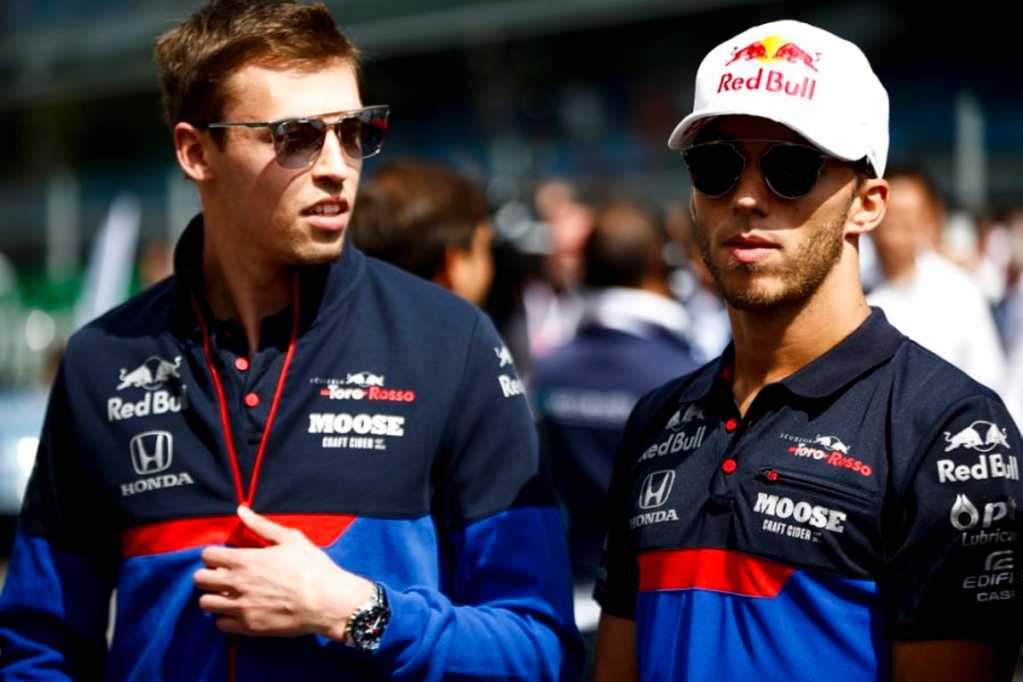
From 2013 to 2025, 5 drivers were brought up to Red Bull after starting a season with Toro Rosso: Daniel Ricciardo (2014), Daniil Kvyat (2015), Max Verstappen (mid-2016), Pierre Gasly (2019), Alexander Albon (mid-2019).
Technically, Liam Lawson could join the list, he never started a season with VCARB because he only filled in for some races in the second part of the season (in both 2023 and 2024) but he did drive for Red Bull’s sister team before being offered an official Red Bull seat for 2025.
The only driver that directly joined Red Bull was Sergio Perez (in 2021), who raced for different teams before that.
Two drivers have had to go the reverse way, losing their Red Bull seat and having to go back to Toro Rosso: Daniil Kvyat (mid-2016) and Pierre Gasly (mid-2019).
competing again
Between 2013 and 2025, 9 drivers got a seat in F1 after not starting (at least) the previous season. It happened once in 6 seasons, and twice in two of them (2016 and 2019).
Due to Kevin Magnussen pulling two comebacks, we witnessed 10 of them in total.
| Driver | Last season started before the break | Length of break (in seasons) | Season of the comeback | Length of the comeback (in seasons) |
|---|---|---|---|---|
| Adrian Sutil | 2011 | 1 | 2013 | 2 |
| Kamui Kobayashi | 2012 | 1 | 2014 | 1 |
| Esteban Guttierrez | 2014 | 1 | 2016 | 1 |
| Kevin Magnussen | 2014 | 1* | 2016 | 5 |
| Robert Kubica | 2010 | 8 | 2019 | 1 |
| Daniil Kvyat | 2017 | 1** | 2019 | 2 |
| Fernando Alonso | 2018 | 2 | 2021 | 5 including 2025 |
| Kevin Magnussen | 2020 | 1 | 2022 | 3 |
| Nico Hülkenberg | 2019 | 3*** | 2023 | 3 including 2025 |
| Daniel Ricciardo | 2022 | 1**** | 2024 | 1**** |
*: Kevin Magnussen replaced Fernando Alonso (McLaren) during the first Grand Prix of the 2015 season (Australia) but he didn’t even get to start the race due to his engine breaking during the warm-up lap.
**: Daniil Kvyat was technically evicted of Toro Rosso during the second part of the 2017 season, missing 5 GPs.
***: During his years without a full-time seat, Nico Hülkenberg got to fill in for 4 races as a Racing Point / Aston Martin reserve driver.
****: Technically, Daniel Ricciardo started the 2023 season without a seat but he replaced Nyck De Vries mid-season (only driving in 7 GPs due to a hand injury in Zandvoort). He also didn’t get to complete the 2024 season after starting it, being laid off after the Singapore GP.
We can notice that most of these comeback happened after the shortest of break (one year for most cases, Robert Kubica the only noticeable exception, especially with Nico Hülkenberg staying close to F1 with reserve drives during his 3-years break).
About half of these comebacks were short-lived, 4 of them only lasting one season and 2 more only going on for two seasons. Then, we have Kevin Magnussen who, in the end, just had two one-year breaks during his relatively long F1 career. And finally, two comebacks that haven’t ended yet because both drivers will be on the grid in 2025: Nico Hülkenberg and Fernando Alonso.
tables

![[MOTOGP – RESULTS] : A study of the 2025 season DNFs](https://virageduraccordement.com/wp-content/uploads/2026/02/54765052116_df71230554_o.jpg?w=1024)
![[MOTOGP – RESULTS] : Who did best within each team and each factory in 2025](https://virageduraccordement.com/wp-content/uploads/2025/12/54833282836_7c4a07bc5e_o.jpg?w=1024)
![[MOTOGP – SURVEYS] : People’s opinion on the 2025 season](https://virageduraccordement.com/wp-content/uploads/2025/12/img_5076.jpg?w=1024)
![[MOTOGP – RESULTS] : An overall look at the 2025 season](https://virageduraccordement.com/wp-content/uploads/2025/11/54816173937_898f5574e6_o.jpg?w=1024)
![[MOTOGP – RESULTS] : A check-up on the first 12 rounds of the 2025 season](https://virageduraccordement.com/wp-content/uploads/2025/07/54354125374_f3762ae206_o.jpg?w=1024)
![[MOTOGP – STUDIES] : Valentino Rossi and his performances by circuit (1996-2021)](https://virageduraccordement.com/wp-content/uploads/2025/05/12437219663_ebd575951a_o.jpg?w=1024)
 virage du raccordement
Laisser un commentaire